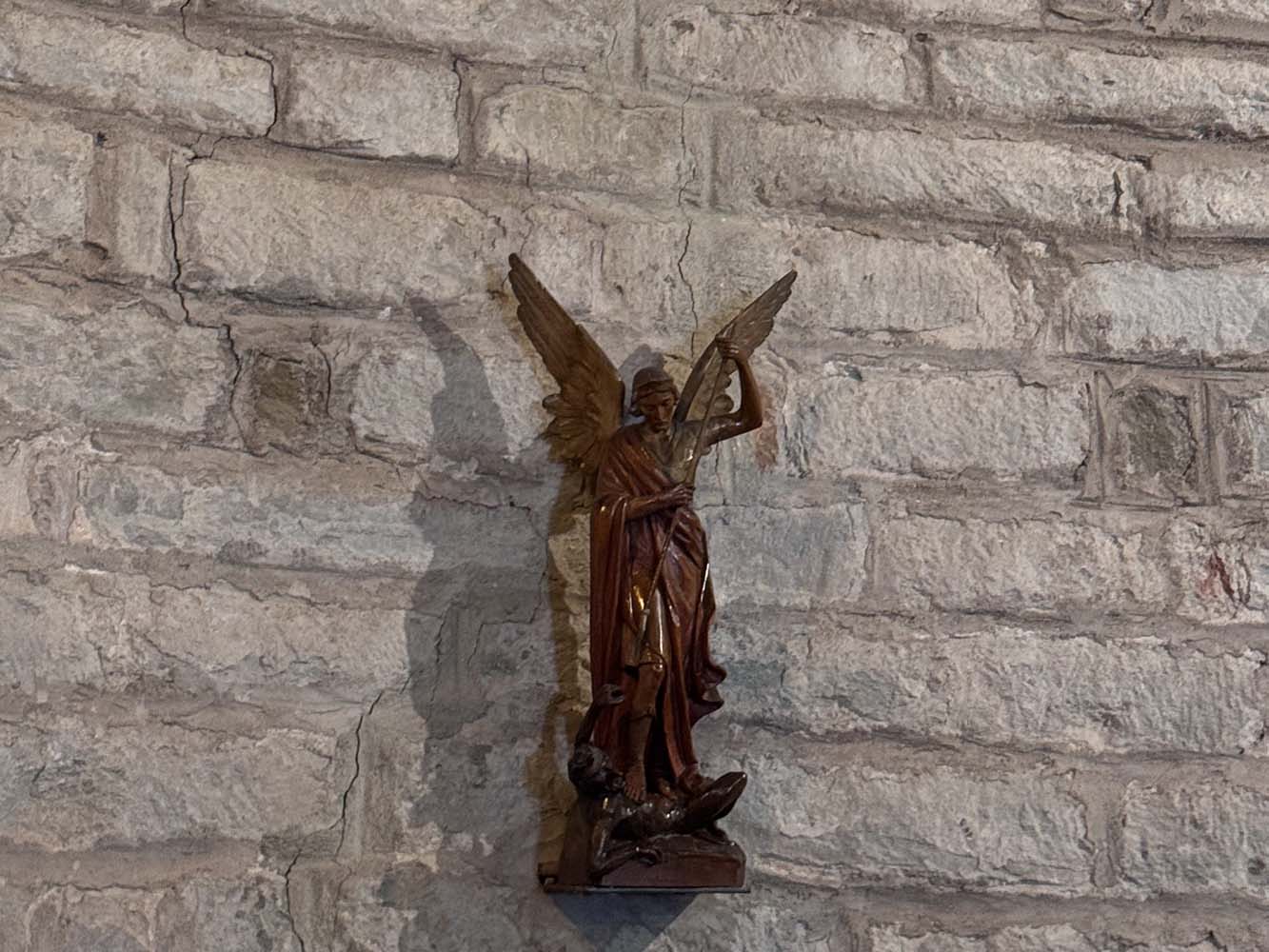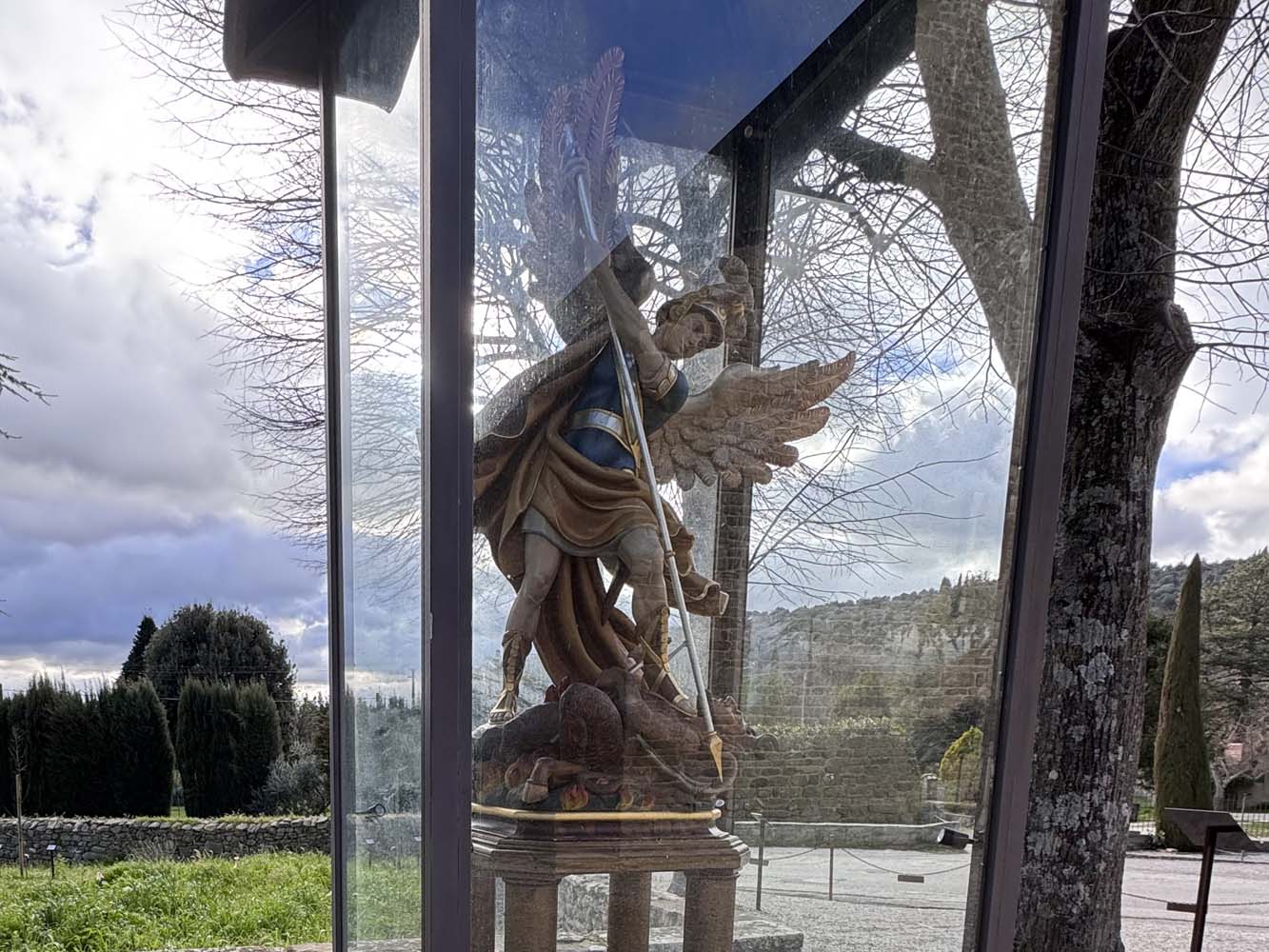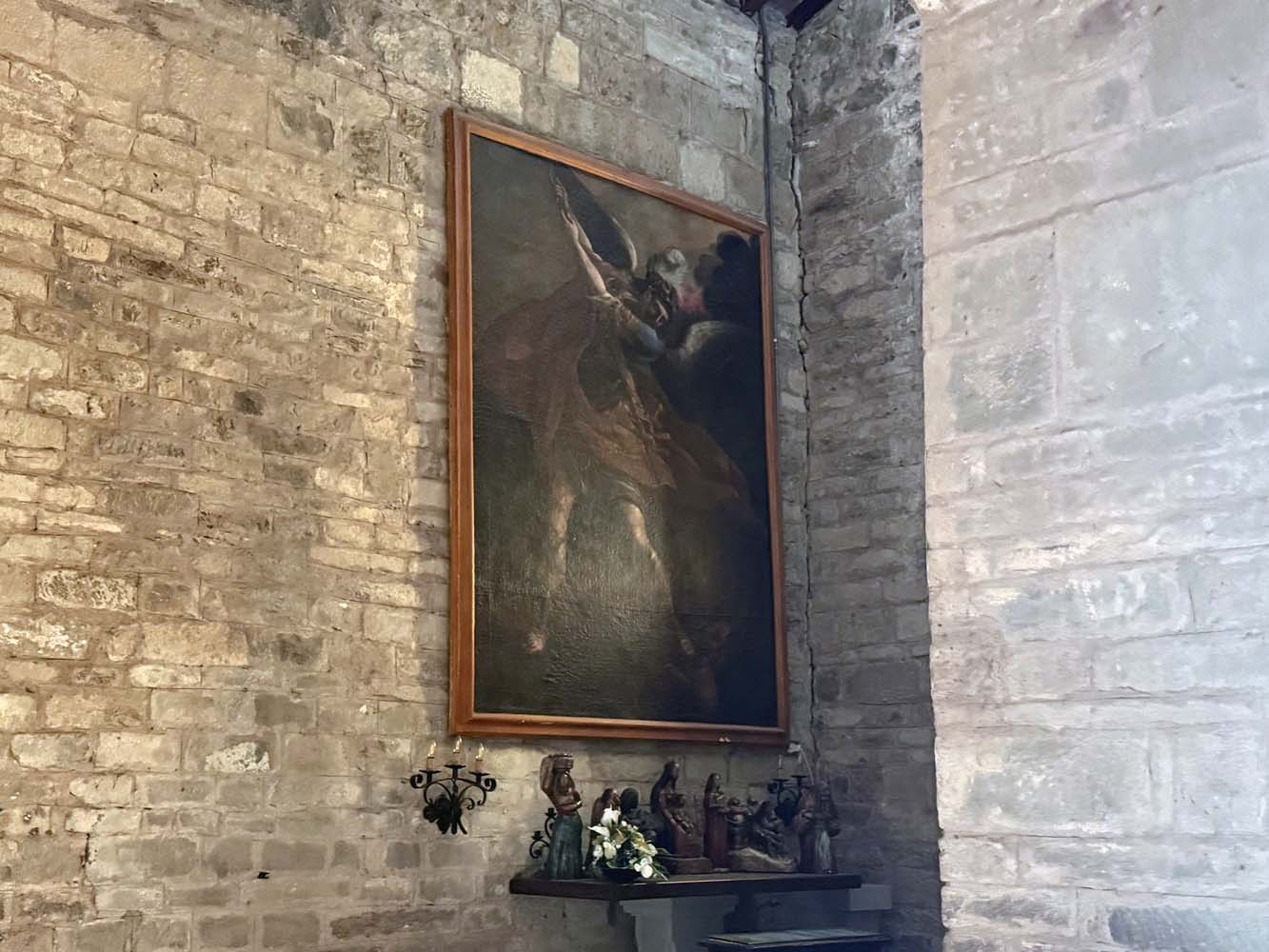
The Archangel Michael
The dedication of our church to Saint Michael the Archangel is a legacy of the Lombard phase of this place of worship – a historical period of which only faint traces remain. The bond between the Lombards and the saint is deeply meaningful, to the point of being regarded as a crucial element of their cultural and religious identity after their conversion to Christianity.
More broadly, Saint Michael the Archangel holds a central place in religious tradition, venerated as leader of the angels, defender of the faith, and protector of the Church. His name, “Mi-ka-el” (“Who is like God?”), is a rhetorical question that underscores his total devotion to God and his rejection of all idolatry or rebellion.
Iconographically, Michael is shown as the warrior Archangel, with sword or spear, defeating the devil – often in the form of a dragon, a symbol of Satan and evil. This imagery draws chiefly from the Book of Revelation, which recounts the heavenly battle between Michael and his angels and this mythic creature (the dragon) and its followers. Michael’s victory symbolizes the triumph of good over evil, of light over darkness.
Insights
The Lombards in Cortona
Information on the Cortona area during the so-called barbarian invasions is extremely scarce, to the point that a city which had been important first in the Etruscan and then in the Roman period disappears from the accounts of ancient historians for centuries.
Yet in the 5th century – fifty years after the fall of the Roman Empire – Cortona probably remained a military stronghold on the frontier between the Goths and the Byzantines, while for some time it no longer exercised administrative control over the surrounding territory.
During the Lombard age (568-774), despite the importance of nearby centres such as Arezzo, Chiusi, and Spoleto, the Cortona mountain area and the Valdichiana – reclaimed from the marsh – formed a territory subject to alternating dominations. This is reflected in place names and cults that at times refer to the Byzantine world and at other times to the Germanic one, and which, under the Lombards, profoundly changed the area’s structure.
With the ancient Via Cassia axis abandoned, the territory was organised around the so-called “Byzantine Corridor”, a more-or-less wide band that allowed connection between Ravenna and Rome and enabled contacts between Byzantines and Germanic peoples that were not always hostile.
The City and the Territory in the Lombard Age
Information on the Cortona area during the so-called barbarian invasions is extremely scarce, to the point that a city which had been important first in the Etruscan and then in the Roman period disappears from the accounts of ancient historians for centuries.
Yet in the 5th century – fifty years after the fall of the Roman Empire – Cortona probably remained a military stronghold on the frontier between the Goths and the Byzantines, while for some time it no longer exercised administrative control over the surrounding territory.
During the Lombard age (568-774), despite the importance of nearby centres such as Arezzo, Chiusi, and Spoleto, the Cortona mountain area and the Valdichiana – reclaimed from the marsh – formed a territory subject to alternating dominations. This is reflected in place names and cults that at times refer to the Byzantine world and at other times to the Germanic one, and which, under the Lombards, profoundly changed the area’s structure.
With the ancient Via Cassia axis abandoned, the territory was organised around the so-called “Byzantine Corridor”, a more-or-less wide band that allowed connection between Ravenna and Rome and enabled contacts between Byzantines and Germanic peoples that were not always hostile.
The City and the Territory in the Lombard Age
At the arrival of the Lombards, while the city was a fortress contested between barbarians and Byzantines and gradually destined to come under Lombard control, the countryside was dotted with abandoned Roman rural villas and small settlement clusters concentrated around early Christian places of worship.
The groups that now reached the area were composed not only of warriors, but also of artisans, women, and children who, after an initial settlement along the main roads – where the ancient villas and the first parish churches stood – preferred to establish themselves in castles: fortified settlement nuclei (sometimes even only surrounded by a palisade or earthen embankments) laid out along secondary routes.
The churches. At least 14 churches in the Cortona territory, including Sant’Angelo, are dedicated to saints of Lombard tradition, although many of the oldest churches do not have typically Germanic dedications and generally appear along the main Roman-age routes.
The castles. The progressive spread of marshland, the need to draw on resources from woodlands and to use uncultivated areas for pasture or cultivation, as well as defensive needs, pushed the population to distribute itself in enclosed settlements – the so-called rural castles – built on sites at a higher altitude than those of the Roman period. In any case, whether in the mountain area or on the hill cone, or in the valley locations that emerged in the part spared by water, these sites did not coincide with those of the preceding age.
The Middle Ages: the Church of Sant’Angelo del Succhio in the Villa of Metelliano
At the end of the 13th century the Comune defined the territorial districts of its contado, distributing inhabited nuclei – made up of villages and castles – across a system of six pievi. Among these, the church of Sant’Angelo del Succhio belonged to the Villa of Mitigliano, which – together with Cavignano-Cesi-Castagni, Montanare, Valecchie, Trebbio, San Bartolomeo di Pergo, San Pietro di Pergo, Tecognano, Montalla, San Marco, and Castel Girardi, belonged to the district of the Pieve of Montanare.
Probably built near a place of worship dedicated to Bacchus, as the reference to “Succhio” would seem to imply, the current building – which nevertheless incorporates Roman-age materials – would date to the 11th century and was likely built over a pre-existing church, datable at least to the 8th century.
Saint Michael the Archangel, Cortona’s First Patron
The dedication to Saint Michael the Archangel was particularly dear to the Lombards, because this saint – represented as commander of the heavenly forces and master of natural powers – lent himself well to a Christian reinterpretation of Germanic mythology.
Devotion to the saint appears widespread and persistent in the Cortona territory, to the point that, beyond the dedication of a monastery located outside the city walls (unfortunately no longer extant), the warrior archangel is confirmed by sources among the patron saints of Cortona.
On his feast day – which fell then as it does now on 29 August – the great end-of-summer fair took place, one of the largest fairs in the territory during the Middle Ages, attracting merchants and buyers not only from Umbria and Tuscany, but also from distant lands.
If, at the beginning of the 16th century, the most beautiful image of Saint Michael among the other civic patrons is owed to the Cortonese painter Luca Signorelli, at the end of the same century the learned tradition is attributed to the Cortonese historian Rinaldo Baldelli. According to this tradition, the serpent defeated by the Archangel would be a Christian interpretation of an ancient biscione, already the city’s emblem, linked in the Etruscan and Roman age to the cult of Aesculapius.